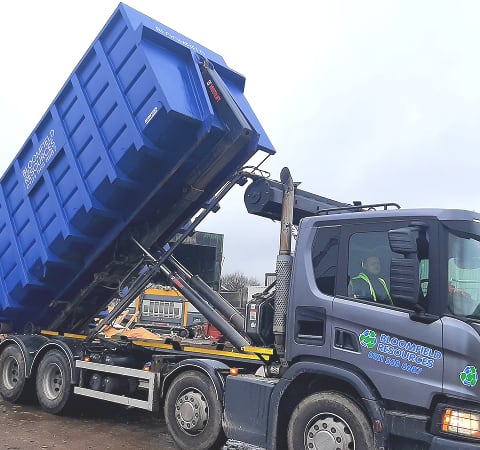
In the fast-paced world of construction, from major commercial developments in Birmingham city centre to residential projects in surrounding areas, like Dudley, Wolverhampton and more. Waste logistics can either make or break a project’s timeline.
For site managers and builders, the choice often comes down to two options: the traditional 8-yard “Builders” skip or the high-capacity Roll-on Roll-off (RoRo) container.
Choosing correctly isn’t just about volume; it’s about site flow, access, and your bottom line.
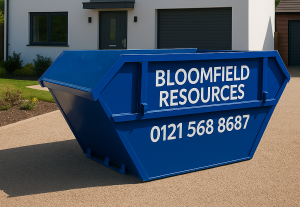
The 8-yard skip is the industry standard for a reason. It is the largest container capable of handling heavy, inert waste such as soil, concrete, and brick without exceeding the weight limits of a standard skip loader.
Click here to view our skips and find a solution for you.
Best For: Groundworks, demolition, and residential renovations.
The Advantage of 8 yard skips: Its compact footprint is perfect for Birmingham’s tighter sites, such as the Jewellery Quarter or Digbeth, where space is much tighter than other areas in the midlands and a larger truck may struggle to manoeuvre.
Permit Friendly: If your project requires placing a skip on a public highway, the 8-yard is the most commonly approved size for local council permits across the West Midlands.
When a project requires a larger volume of waste, naturally it will increase require larger solutions. This is where the 20–40 yard RoRo becomes the superior choice for high-volume sites.
Click here to see our RoRo hire services.
Logistical Efficiency or RORO hire: One 40-yard RoRo movement replaces five standard skip deliveries. In a busy hub like Birmingham, reducing vehicle movements by 80% significantly lowers site congestion and reduces the time spent managing traffic marshals.
Sustainability: Fewer truck movements mean a lower carbon footprint for your project—a key requirement for modern “Green Building” tenders and public sector contracts.
Best For: Bulky, light waste such as timber, plasterboard, plastics, and large-scale industrial clearances.
The short answer is yes, if it’s used for the right things. On a large construction site in Birmingham or Tipton, an 8-yard skip is rarely used in isolation. Instead of being the only bin on site, it acts as a central container. Site managers generally use 8-yard skips for heavy, dense materials like soil, concrete, and bricks.
Where we see builders go wrong is hiring smaller skips or only one 8-yard skip, filling it with light timber and cardboard in two hours, and then calling for a “swap.” If you do this four times a week, you aren’t just paying for the waste; you are paying for four separate truck journeys, four sets of paperwork, and four times the site disruption.
The Pro Insight: For a large site, the 8-yard is “big enough” for your groundwork’s and masonry, but it’s usually “too small” for your fit-out and packaging waste. So be sure to choose what waste you put in here, wisely.
The most efficient sites in the Midlands don’t choose one or the other—they use a mix of the two.
By separating your waste this way, you maximise the capacity of every truck leaving your site.
If you look at a price list today, a single 8-yard skip is cheaper than a single 20-yard RoRo. That’s a fact. However, looking at the “unit price” is a mistake many people make. The Short-Term View
The Long-term View If you have 40 yards of heavy waste to clear from a site…
Even though the RoRo costs more upfront, in the long run, the RoRo can be significantly cheaper. This will vary depending on the type of job you need it for, but ultimately if you take the time to consider the scale of your job and waste types you should be able to find the best solution for you.
We offer both because a successful project usually needs both. We aren’t here to upsell you; we’re here to “right-size” you. If we see you’re ordering an 8-yard every other day, we’ll be the first to suggest a RoRo to help you save on those transport costs.
If you’re not sure which solution to go for, get in touch today!

Bloomfield Resources
Follow us

Choosing the wrong size is one of the most common mistakes customers make. This guide covers every skip we offer, with real examples of...

Within its first year of trading, Bloomfield Resources has achieved an exceptional environmental milestone, successfully recovering and recycling 90 percent of all waste generated...
On busy sites, waste builds up quickly, and the last thing you need is a full skip slowing everything down. That’s where skip exchanges...
 Fast, hassle-free booking
No hidden fees
Trusted by homeowners and businesses alike
Fast, hassle-free booking
No hidden fees
Trusted by homeowners and businesses alike


 My Basket

 Book A Skip